The Wall Motif
The Hanging GirlThe wall motif turns Wanda Phinn’s experience of exclusion into a recurring physical image. First it stands between her security post and the pleasures of Victoria Embankment Gardens; later, another wall darkens the view from her apartment. When Wanda leaves her job, the first wall seems to fall away, and with it the routine that had made her feel imprisoned. The image links restricted circumstances to the hopes that propel her toward Atu Abanshamash Dumuzi, without making clear that a change of direction has erased the barriers around her.
A View from Behind Glass
At the rear entrance of a large company on the Strand in London, Wanda watches people pass through glass doors into a world whose secrets she guards without knowing them. Her position is both employment and enclosure: she enables other people to enter, while remaining alone in the space between access and the riches it appears to promise. The threshold gives her a view of movement without participation. She can observe the system, but her work does not bring her closer to the opportunities it represents.
Day after day, she looks through the doors across Savoy Place to the wall around Victoria Embankment Gardens. Behind it, people sit in striped deck chairs in the sun and eat ice cream bought with money they can afford to spend. The scene matters not simply because the park is pleasant, but because its ordinary ease sharpens Wanda’s sense of separation. The wall makes leisure visible and inaccessible at once; what others enjoy without concern becomes, for her, a silent torment. Her attention fixes on the boundary as much as on the life on its other side.
The Wall as an Identity
The prolonged act of looking becomes a name for Wanda’s condition. Her new identity is that of the woman who looks at walls: a person defined not by entry into the life she watches, but by the boundary that keeps her watching. This is a bleak transformation of the security job’s routine. She is meant to monitor passage through the entrance, yet her own days are marked by what she cannot pass through. The image condenses her position into a repeated gesture rather than a dramatic confrontation.
The wall also gives form to her fear that her life has fallen short of what it might have been. Wanda sees her security uniform and concealed hair as an unflattering endpoint for the histories and inheritances that preceded her. Her father’s pride in her mixed ancestry stands beside her mother’s practical advice to keep a cool head; neither changes the grey, subordinate work she inhabits. The wall gathers these tensions into a stark contrast between imagined possibility and an existence she experiences as inconsequential. Wanda still stands upright as better-off visitors pass, trying to recover the part of herself that might carry her away from it.
The Image Moves Indoors
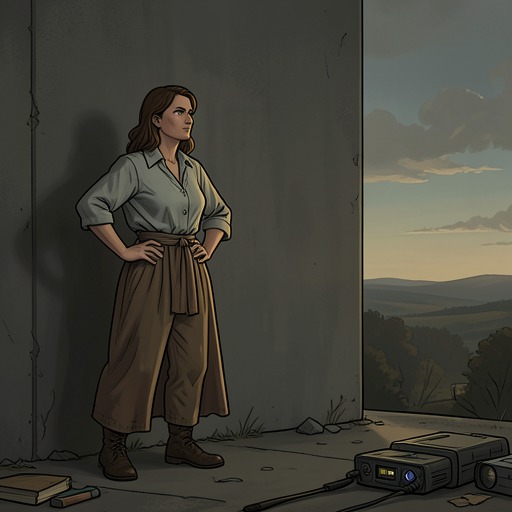
After work, the motif returns at the window of Wanda’s apartment. The outside world appears as another wall, now described as towering above her and blocking light and dreams. The change of setting does not bring release: the boundary she had watched from her post seems to follow her home. The wider neighborhood, too, is imagined through frustrated hopes. People dream of becoming soccer players, rock stars, or trophy wives, while education and realistic ambitions seem to offer opportunities that remain distant for most. Wanda already knows how narrow the chances of reaching wealth and happiness are; the wall makes that knowledge part of the view from her own room.
This recurrence prevents the image from belonging only to one workplace. At the company, the wall separates her from visible leisure; at home, it blocks light and becomes a figure for the unfulfilled hopes around her. In both scenes, Wanda sees a world beyond a boundary and measures her prospects against it. Yet the apartment passage also places her hopes within a community of people who want lives different from the ones available to them. The wall is therefore both personal and shared: it marks Wanda’s confinement while reflecting a wider gap between aspiration and opportunity.
Leaving the Boundary Behind
In September 2013, Wanda leaves her security job without handing in notice. She throws her cap on the floor, says goodbye to the woman at the control desk, and slips out. The wall around Victoria Embankment Gardens then seems to slide away without regret, as do the worries of wasted days and the fading sounds of the park. The reversal is sharp: the place that had organized her longing no longer holds her gaze. Leaving the post changes her relation to the wall, from someone stationed in front of it to someone who believes the world has opened before her.
That sense of freedom is bound to Wanda’s plan. Ever since Atu caressed her cheek, called her his flower, and kissed the back of her hand, she has believed him to be the future she had dreamed of. She tells Shirley of her realization and faces her friend’s continuing warnings, including the risk of spending her savings on a venture from which she may have nowhere to return. The wall’s apparent disappearance thus accompanies hope, not proof that Wanda’s circumstances have been secured. Across the motif’s two movements, the book sets the confinement of repetitive looking against the momentum of chosen departure: the boundary loses its immediate power, while the longing that formed around it continues to shape what Wanda believes lies ahead.